
The Approaching Singularity: Part I
Two Singularity Events running in parallel seem to be on a collision course. I see them defining the future of our field.

In my career, the single largest leap forward has been SBRT. Less fractions, more concentrated dose, a simple and singular goal:
Put ablative dose into the target and have rapid collapse of the dose beyond the target.
It has moved the needle more than arguably anything else in my thirty years, but it has also changed the model for how we practice and placed financial pressures on our field as we move more towards shorter and faster and in some ways “simpler” treatments.
Today I want to take a step back and view this from a more distant perspective. To zoom out far enough that the shape of where we are heading becomes visible. SBRT was the foundational piece that defined our path toward singularity. These two articles will trace that trajectory - and then examine how accelerating pharmaceutical development, expanding theranostics, and the 2026 restructuring of our financial architecture are all converging on the same point.
As I was drafting this article, March 5th, 2026 a review article was published in the NEJM (LINK):
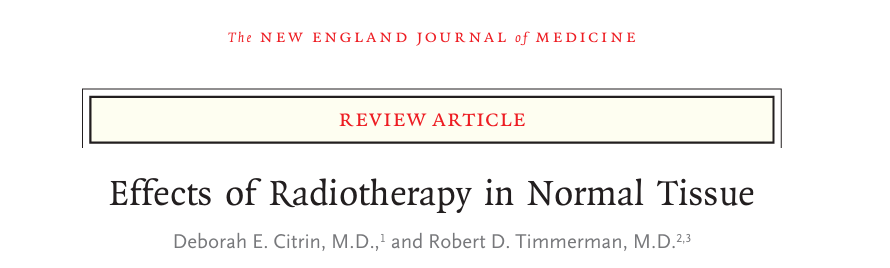
Take a day and read it. Packed with history and context and amazingly pertinent as you’ll soon see. Robert Timmerman - covered on my Substack here: The World According to Timmerman - is one of the two lead authors and is a foundational player in the development of SBRT in the US.
In ways, it echoes our discussion today so I’m not the only one seeing these clear broad trends. Where these Substack pieces might be unique is the pairing of what we see in our field to the rapid change that is occurring in the world due to AI. And then looking at how those two Singularity events might interact upon our specialty.
With that background, let’s begin.
The Singularity
It’s a term borrowed from physics: the point of infinite density at the center of a black hole where gravitational forces become so extreme that the known laws of physics break down. The rules, as we understand them, simply cease to apply.
Around this point in the spacetime continuum is the “Event Horizon” - the invisible boundary beyond which no object can travel fast enough to escape the pull towards the singularity. Not even light. Once the event horizon is crossed, everything “flows” down towards the singularity at increasing speed.

This metaphor has become ubiquitous in discussions of artificial intelligence. We speak of an approaching technological singularity: the moment when recursive self-improvement in AI triggers runaway capability growth and the future becomes fundamentally unpredictable. We sense we are nearing - or may have already crossed-that invisible threshold in the world of AI. To me, this is the “external” singularity that will impact our field.
Within radiation oncology, I think we are approaching a different kind of singularity. What I see is an ever-increasing gravitational pull toward the fundamentals that have driven the success of SBRT. Shorter courses. Tighter dose circles. A dense ball of dose at the tumor with little else truly impacting outcomes.
This has been our “gravitational force” for the past few decades. It has been pulling us towards our present and future. It has created significant impact on our field and, just like in the physical world of a black hole, the closer you get to singularity, the stronger the pull becomes.
Two singularities. Two event horizons. Running in parallel - and about to intersect.
The Same Starting Line
Amazingly the two history begin at nearly the same moment in time.
On the AI front: 1943, McCulloch and Pitts publish the first mathematical model of an artificial neuron. 1950, Alan Turing writes “Computing Machinery and Intelligence” and asks the question that still haunts us: Can machines think? 1951, Minsky and Edmonds build the world’s first physical artificial neural network.
Compare that to our own history. In 1951: Leksell publishes “The stereotaxic method and radiosurgery of the brain” - the foundational theoretical paper for our field. Both histories begin at essentially the same moment. Two parallel tracks, laid down in the same decade, now converging.
And along the way, both fields have seen remarkable stepwise progress. For our field, here are just a few notable steps: The first Gamma Knife in Stockholm, 1967-68. Early linac-based SRS in the 1980s. RTOG 9508 building momentum for SRS in the trial setting. Slow incremental progress creating the foundation for where we are today.
Crossing the Event Horizon:
Momentum Becomes unstoppable
For AI, the event horizon was November 30th, 2022 - the day OpenAI released ChatGPT to the public. Whatever you thought about AI before that date, the world looked different after it. The viral moment reframed expectations and opened a floodgate of investment with trillions of dollars now flowing into a space that had been quietly building for decades. The ability to meaningfully slow that rate of progress is, in all likelihood, behind us.
For our field, I’d argue the event horizon came earlier, and in contrast, rather quietly. With hindsight, the defining moment was a 2003 Phase I study from Robert Timmerman (author of NEJM article as well) and colleagues: “Extracranial stereotactic radioablation: Results of a phase I study in medically inoperable stage I non-small cell lung cancer.” It opened our eyes to what our singularity actually looked like:
Put a lot of dose in the target and have steep gradients.
That’s it. That’s the simple idea that everything since has been built around.
Returning to the NEJM article by Citrin and Timmerman, three passages near the opening struck me for how precisely they echo what I’m describing here.
On the trend toward treating only visible disease:
“Ultrahypofractionated treatments, such as stereotactic radiosurgery in the brain and stereotactic ablative radiotherapy at other body sites, typically target only visible disease and are now commonly used for localized disease and metastatic deposits.”
On the retreat from elective nodal coverage to gross disease only:
“The availability of more independently effective systemic therapies, coupled with the ability to use radiotherapy to more precisely treat visible disease and spare grossly uninvolved tissue, has led to an approach that capitalizes on the concept of spatial cooperation.”
And perhaps most concisely, on the trajectory of our field over decades:
“One example of this trend is the treatment of some lymphomas, for which radiotherapy has evolved from total nodal irradiation to mantle field irradiation to involved-field irradiation to involved site irradiation.”
Volumes are shrinking. Fractions are shrinking. Targets are becoming more and more focused on visible disease.
We are on our own path to Singularity.
The March Forward
Once you see the pattern, it appears everywhere.
Lymphoma: total nodal irradiation → mantle field → involved field → involved site.
Lung: subclinical at-risk volumes → PET-avid disease.
Brain metastases: whole brain → SRS to individual lesions.
Breast: tangential fields → accelerated partial breast irradiation.
And the more subtle shifts that don’t always make the headlines:
Pelvic nodal coverage: no real benefit - RTOG 0924 just delivered that verdict.
Liver disease: once largely untreatable with radiation, now responds beautifully to SBRT.
Renal lesions: SBRT via FASTRACK II, 100% local control in a randomized trial.
Pancreas: control the disease at the primary, and perhaps some nodal coverage, but the targets are shrinking.
Head and neck: even here, our progress is dropping subclinical uninvolved levels and reducing doses to at-risk regions.
You can find counter-examples at the margins. Spinal SBRT, for instance, remains a case where we intentionally treat an extra anatomical segment beyond visible disease - and with good reason, given the consequences of a nearby miss. But even here, does anyone genuinely believe that improving imaging won’t steadily erode the benefit of that additional complexity? Better drugs, better imaging, and the justification for treating beyond gross disease, even there, will narrow.
Everything in our field is generally falling towards “singularity”. In simple terms, we have crossed our Event Horizon and we are accelerating towards a more singular approach than at any point in my 30-year career. This is really undeniable if you take a broad perspective - it’s the central theme of NEJM review.
And today, it is not simply the direction, but it is the manner in which a number of factors both inside and beyond our field will (I believe) dramatically begin to accelerate our push towards our own singularity - that is really today’s focus.
At Medicine’s Pace
I can already hear the reasonable objection to my vision of a more pronounced acceleration being imminent:
“Our field moves slowly. It always has. You just said our event horizon was crossed over twenty years ago - and here we are, still using fax machines. And we still do a ton of stuff that isn’t SBRT based. There will be change, but it will stay measured.”
And all that’s true. And all of that makes sense. Medicine is more regulated, more cautious, more appropriately deliberate than the technology sector. The users of our field’s innovations - patients, physicians, institutions - carry enormous inertia. Progress that would take two years in software takes a decade in a clinical trial. The machinery of evidence-based medicine is slow by design.
But consider what that means when set against the backdrop of an AI acceleration that is measured in months, not years. Our singularity has been building for two decades at medicine’s pace. The AI singularity crossed its event horizon three years ago and is moving at the speed of capital - with trillions of dollars actively compressing timelines.
Our Payment Struggles
We’ve been in a struggle to fight for the value we provide for the last 10-15 years - after all, if the spending in pharma grows (which it has), other places get less. I’d argue that we have largely lost ground in that battle - year over year, a slow assault of the margins. We didn’t win the compensation battle despite providing higher value and better care. That’s really a fundamental theme of this entire Substack - Radiation Oncology represents tremendous value today in oncology and yet, we struggle to appropriately advocate for our value.
And in 2026, the scales will be further imbalanced - significantly. Accelerant is being literally poured onto the pharmaceutical approaches via investment in AI and robotics. Meanwhile the changing reimbursement within radiation oncology absolutely hammers many existing programs and makes new center development untenable in many circumstances. Some facilities are seeing total revenue fall by 20% or more with more than two-thirds seeing a greater than 10% fall in revenue (ASTRO Survey). This is absolutely consequential to our field and defines a new, still-evolving CapEx framework for our specialty.
I spoke about this risk to revenue early - literally within minutes of hearing our approach - I saw where we are today as the most likely outcome scenario. And I reiterated those comments after the preliminary rule announcement as others tried to argue we would correct the “error in cross-walking” of the codes via the official comment period. I wasn’t in the room - perhaps it was our “only path” - but I don’t think so, and from the moment I heard the approach, it has seemed like a clear misstep. This new payment structure now becomes the path we must navigate as we race AI and progressive drug development.
Summary: The Collision Ahead
Radiation Oncology has had a clear trajectory for the last few decades - shorter courses with a general tightening of margins and a reduction in treatment of “regions at risk” as we pour more and more dose into tighter targets.
AI will apply a new and unique pressure to our field. It will compress competing timelines for alternative approaches as we all strive to achieve better outcomes for patients. The gap between the pace of medicine and clinical research and the surrounding “world’s pace” will widen. Pharmaceuticals backed by trillions of dollars of investment will accelerate. Theranostics will expand in parallel - again with their development pushed faster via AI. And the imbalance of payments will define our field in many important aspects over the next years ahead.
From my perspective, the more clearly we see what lies ahead, the better positioned we will be to help shape it. If we don’t become faster, more active, and more unified as a field, we risk pharma defining “our singularity”. The first step is simply recognizing the direction we’re already heading.
Though these curves and events can be viewed as independent, they are converging. And to me, the collision looks imminent.
Next week in Part II, we’ll look a bit deeper at what this convergence might bring.
As always, thanks for reading and keep pushing for better!